The Aître Saint-Maclou.
A courtyard of carved wooden galleries built over a plague pit — one of the most unusual and atmospheric places in Rouen, and free to wander.
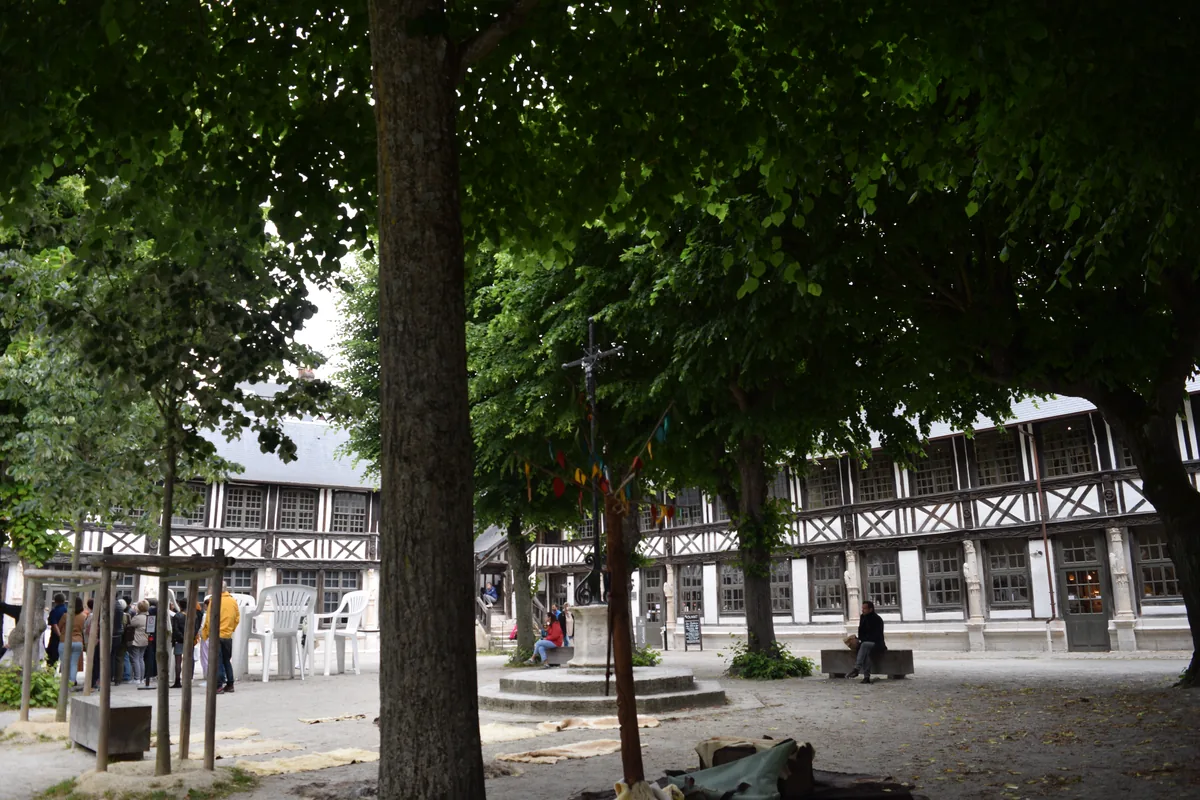
A courtyard hiding a dark history
You could walk straight past it. Set just behind the flamboyant Gothic church of Saint-Maclou, the entrance is an unassuming passage that opens onto one of the strangest courtyards in northern France — a square of half-timbered galleries that once sat above a mass burial ground.
In medieval Rouen, graveyards filled fast. After epidemics struck the city in the 14th century, the parish of Saint-Maclou bought this plot to expand its cemetery. The galleries that ring the square were built to store the bones of the dead — an ossuary — so that older graves could be reused. This is what the word "aître" means: a churchyard, a place of the dead. Dozens of these aîtres existed across medieval Europe; today the Aître Saint-Maclou is one of the last survivors, and the best preserved.
The macabre carvings
The real treasure is above head height. Spend a few minutes circling the courtyard and you will notice the dark oak beams and columns are carved — a full danse macabre in wood. Skulls with empty eye sockets, crossed shinbones, gravediggers' spades, hourglasses, coffins and pickaxes run along the galleries in grim, repetitive rhythm.
It is a memento mori, a constant reminder that death comes to everyone, carved in the 1520s. The carving is naïve but deeply expressive, and astonishingly well preserved for five centuries of weather. For most visitors it is the single most striking thing in the courtyard — and it is quietly easy to miss if you do not look up.
The mummified cat
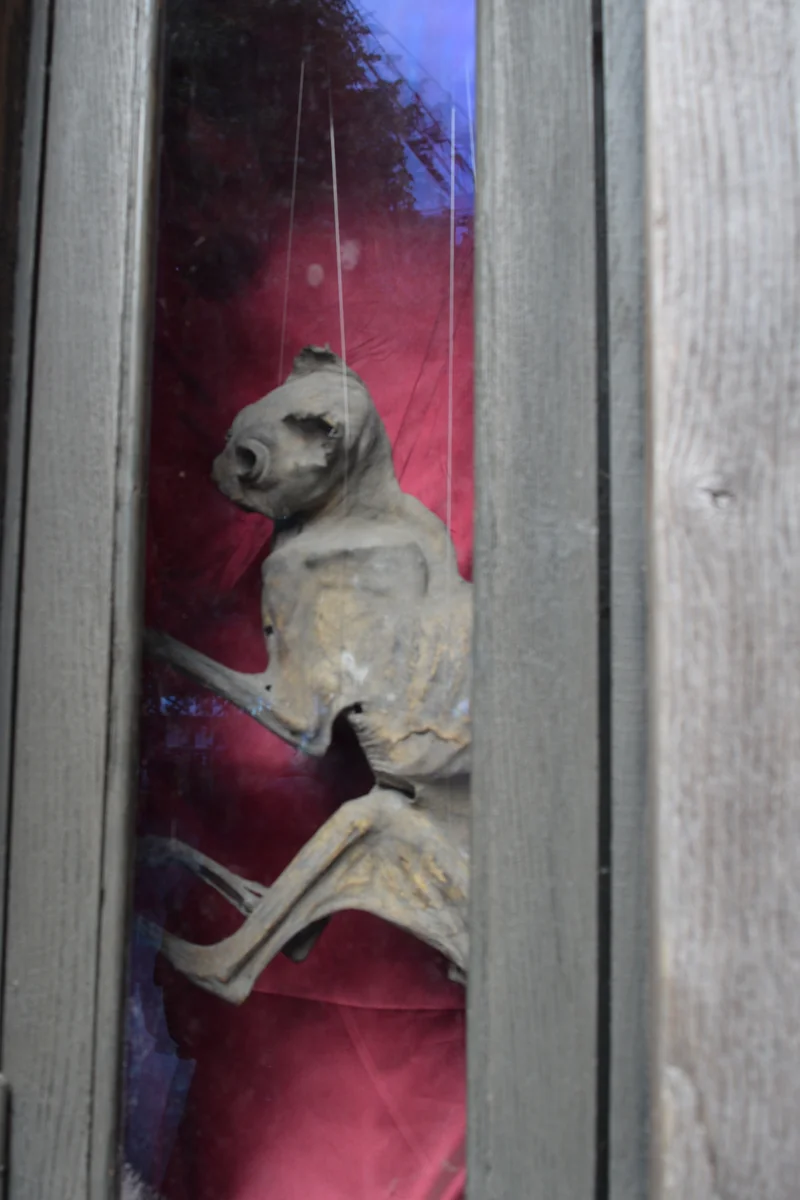
One of the Aître's stranger exhibits is a mummified cat, preserved in a case in the old masonry. Cats found walled up in the timber frames of old Norman buildings were sometimes placed there as protection against rats — and, in folk belief, against evil spirits. The dry conditions of the charnel house have kept this one intact, right down to its fur and claws.
Children especially love it; adults tend to find it oddly moving. It is a reminder that the Aître is not a pristine monument but a lived-in, layered place — part plague cemetery, part folklore, part art school. Look for it in the display case along the gallery wall.
From ossuary to art
Long after the burials stopped, the courtyard found new lives. In the 19th century it became a boys' school, then part of the city's School of Fine Arts. Restored and reopened in 2020, it now hosts art and craft galleries, workshops and exhibitions around its serene central square.
Recent restorations have also revealed the tall carved wooden posts and, in places, traces of 17th-century wall paintings. Stroll slowly, look up at the beams, peek into the workshops, and you will understand why locals and guides alike call it one of the most atmospheric corners of Rouen. On several summer weekends it doubles as a small market of Norman crafts.
A memento mori worth lingering on
Allow twenty to thirty minutes — longer if you want to browse the galleries. It sits within an easy stroll of Rouen Cathedral, following the same medieval street network, and makes a natural pairing with a wander through the old town in our guide to things to do in Rouen. Come in the late afternoon, when the quiet square fills with warm light and you can have the carvings almost to yourself.
Tours that begin in Rouen
The Aître is easy to explore on foot, but a guided walking tour adds the history you will not find on the walls. These experiences start in Rouen itself:
- Rouen: Historic Guided Tour of the Old Town — the medieval quarter, the cathedral square and the half-timbered lanes around Saint-Maclou.
- Rouen: Audio Guided City Tour — wander the old town at your own pace with stories in your ear.
- Rouen: Must-see Private Walking Tour — a compact orientation tour hitting the city's landmark monuments.
Armada hotels
Questions before you go
Is the Aître Saint-Maclou free to visit?
Access to the courtyard is normally free; some galleries and guided experiences may charge a small entrance fee.
What is the Aître Saint-Maclou?
A 14th–16th-century plague cemetery and charnel house in Rouen, ringed by timber galleries carved with skulls and bones.
Where exactly is it?
In Rouen's medieval quarter, just behind the church of Saint-Maclou, a few minutes' walk from the cathedral.
How long should I spend there?
Twenty to thirty minutes for a good look at the carvings and galleries; longer if you browse the exhibitions.
Is it suitable for children?
Yes — the mummified cat and the carved skeleton decorations are usually a big hit with kids.
Can I take photos inside?
Photography of the courtyard and carvings is generally allowed.