Monet & Rouen Cathedral.
Rouen is the cradle of Impressionism — and its cathedral became Monet's most famous obsession. Here's the story, and where to see the paintings.
The most famous façade in art
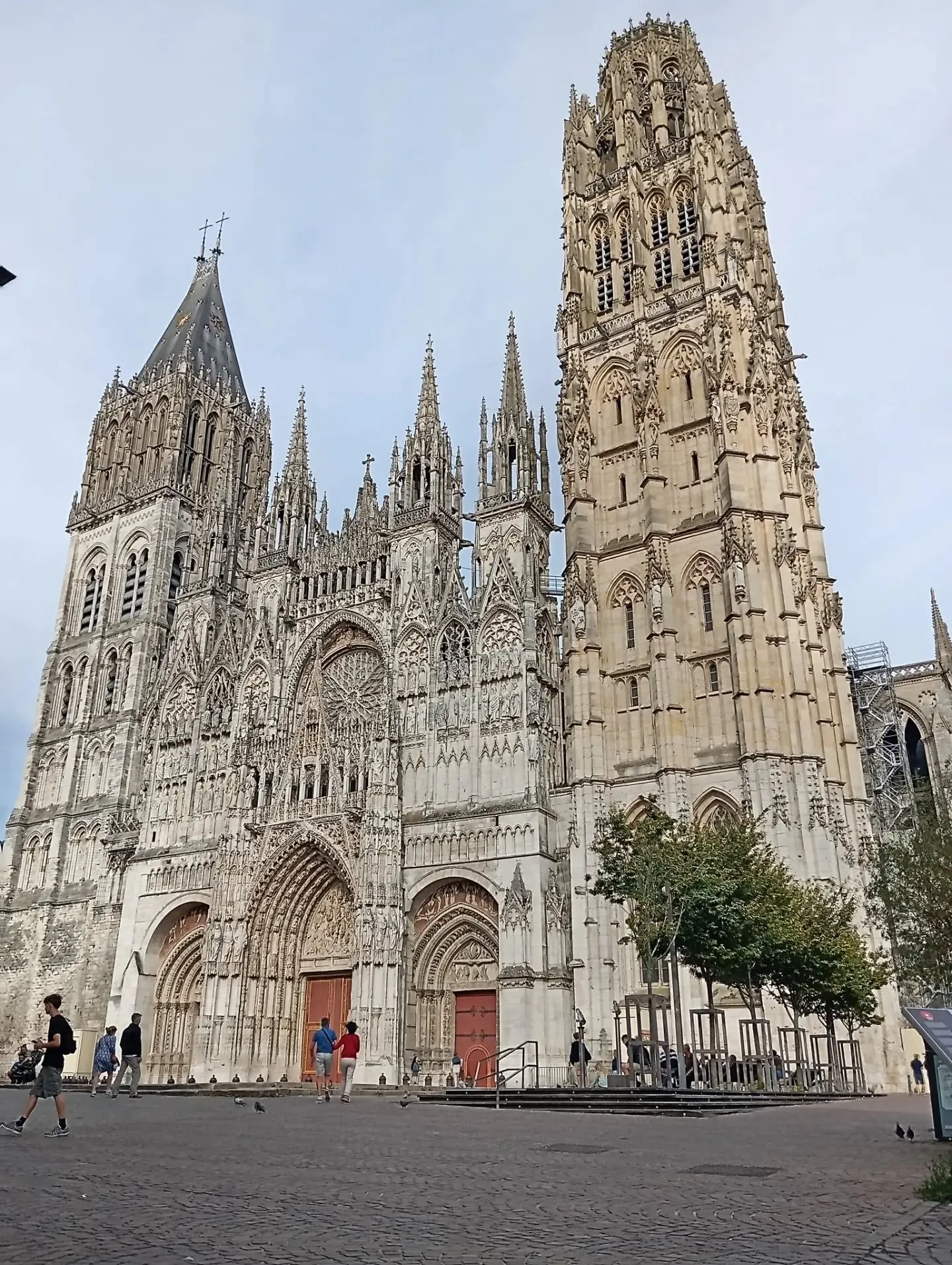
Between 1892 and 1894, Claude Monet painted the west façade of Rouen Cathedral more than thirty times. Working from rooms overlooking the Place de la Cathédrale, he captured the same stone again and again — at dawn, at noon, in fog, in full sun — chasing the way light dissolves form. The series is one of the milestones of modern art.
Monet worked from rented rooms on the second floor of a building on the Place de la Cathédrale, screening his window to control the light. He kept returning to the same motif because, as he put it, the façade “dissolves” — the subject is not the stone but how light touches it. He began the series in 1892, refined the canvases back in his Giverny studio through 1893–94, and finally exhibited around thirty of them in Paris in 1895.


.webp)
 📸 Rouenenphoto
Where Monet stood
You can stand on the Place de la Cathédrale today and look up at exactly what Monet saw. The light still shifts across the Gothic lacework hour by hour — and in summer the façade comes alive again with the free Cathédrale de Lumière light show.
Monet looked out onto the square from the second floor — you can stand in roughly the same spot on the north side of the Place de la Cathédrale and frame the west façade just as he did. Look for the great rose window and the flamboyant Gothic Tour de Beurre (the “Butter Tower”, paid for by medieval indulgences for butter during Lent). The clearest views come in the morning when the sun hits the portal straight on.
See a Cathedral canvas — for free
Most of the series is scattered across the world's great museums, but you don't have to leave Rouen to see one. The Musée des Beaux-Arts de Rouen holds Monet's La Cathédrale de Rouen, le portail et la tour d'Albane, temps gris (1894), alongside his Vue générale de Rouen.
The Musée des Beaux-Arts de Rouen sits a short walk from the cathedral at Esplanade Marcel Duchamp. The permanent collection — including the Monet cathedral canvas — is free to enter, which makes it one of the easiest Impressionist paintings to see in the whole of France. Most of the rest of the series hangs in Paris (Musée d’Orsay), Washington (National Gallery) and Boston (Museum of Fine Arts), so Rouen is the only city where you can see the original subject and one of its painted portraits in the same day.
The best Impressionist collection outside Paris
The museum has the largest collection of Impressionist paintings in France after Paris — a legacy of the 1909 Depeaux donation — with works by Pissarro (his Pont Boieldieu in Rouen), Sisley, Caillebotte and Renoir, plus the painters of the local École de Rouen. Best of all, the permanent collection is free to visit.
Make a day of art
Combine the museum with a walk past the Gros-Horloge and the cathedral itself — see all the highlights in things to do in Rouen. Monet's gardens at Giverny are an easy day trip away.
Where the thirty canvases are today
Monet finished around thirty paintings of the cathedral for his 1895 Paris exhibition, and kept enough studies back in his Giverny studio to push the total beyond fifty works in the series. They are now scattered across the great museums of two continents — but you can see where each of the main groups landed:
- Rouen — Musée des Beaux-Arts: Le portail et la tour d’Albane, temps gris, the one painted canvas that still lives in the city where the artist stood.
- Paris — Musée d’Orsay holds the biggest single group, including Le portail, soleil matinal and Le portail et la tour d’Albane, plein soleil.
- Washington, DC — National Gallery of Art: West Façade, Sunlight, 1894 and its famous Harmony in Blue and Gold.
- Boston — Museum of Fine Arts, and New York — the Metropolitan Museum & the Museum of Modern Art, each with several canvases.
- Further studies and smaller versions hang in Moscow’s Pushkin Museum, the Getty in Los Angeles and across private collections.
That spread is exactly why a week-long city break in Normandy is the smartest way to see the series: Rouen is the only place where the original subject and one of its painted portraits are visible within the same walking day.
Practical tips for visiting the cathedral
To make the most of the visit, aim for the morning light, when the sun strikes the west façade face-on — the direction Monet painted most often. The spot to stand is the centre of the Place de la Cathédrale, roughly where his second-floor studio looked down onto the square.
- Cathedral entrance is free — you only pay for the guided tower climb and the crypt and treasury at the west portal.
- Give the façade a focused 15–20 minutes (longer if you are framing photos); the interior itself deserves another 45 minutes to an hour.
- The nave is open daily, generally from morning until early evening — check the board at the portal for mass times, when visitors may be asked to stay at the back.
- In summer, time your visit to end as dusk falls, when the west façade glows again during the free Cathédrale de Lumière projections.
See a Monet canvas in Rouen — your questions
How many times did Monet paint Rouen Cathedral?
More than thirty views of the west façade, painted between 1892 and 1894 — around thirty were exhibited in Paris in 1895, and studies pushed the total past fifty works.
Can you see a Monet cathedral painting in Rouen?
Yes. The Musée des Beaux-Arts de Rouen holds his La Cathédrale de Rouen, le portail et la tour d’Albane, temps gris (1894) — and the permanent collection is free to enter.
Where is the rest of the series?
Mostly in Paris (Musée d’Orsay), Washington (National Gallery) and Boston (Museum of Fine Arts), with groups in New York, Moscow and Los Angeles.
Where exactly did Monet stand?
He worked from a rented second-floor room on the Place de la Cathédrale, screened to control the light — you can stand on the same square today and frame the same façade.
Is the cathedral free to visit?
The cathedral itself is free; only the tower climb, crypt and treasury are paid. The permanent collection at the Musée des Beaux-Arts is also free.
When is the best time to see it as Monet saw it?
In the morning, when the sun hits the portal straight on — and again at dusk in summer for the free Cathédrale de Lumière light show.
Where to stay: hotels near Rouen Cathedral
Base yourself a few minutes' walk from the cathedral for the light show and the old town. These are our picks closest to the facade Monet painted:
Hôtel de Bourgtheroulde → Mercure → Novotel → Hôtel Cardinal →
Hôtel de Bourgtheroulde (five-star, in a Renaissance mansion, steps from the cathedral) is the landmark pick; Mercure Rouen Centre Cathédrale and Novotel Rouen Centre Cathédrale are polished mid-range options; Hôtel Cardinal is simpler and genuinely close, with some rooms facing the facade. Walk out at sunset for the Cathédrale de Lumière show. See our full best hotels in Rouen guide for every budget.
Visit Giverny: Monet's House & Gardens
From Rouen, the classic excursion is Giverny — Claude Monet's house and the flower and water-lily gardens he created and painted. It is under an hour away. Book a guided visit or entrance ticket below:
 Giverny · Monet
Monet's House & Gardens — Guided Tour
Licensed local guide through Monet's home, the water-lily garden and the Japanese bridge.
from €69 — Book on GetYourGuide → Giverny · Monet
Monet's Home & Gardens — Half-Day Trip
From Paris to Monet's house and gardens with an expert guide. Round-trip transport included.
from €74 — Book on GetYourGuide → Giverny · Monet
Giverny by Classic Car
Chauffeured classic-car tour of Giverny from Vernon — the most scenic way to arrive.
from €115 — Book on GetYourGuide →At Giverny — stay in Monet's village
Staying in Giverny lets you reach Monet's garden before the crowds and keep painting views to yourself after hours. The village is small, so book these early:
La Musardière → Blanche de Castille → Hôtel Baudy → Le Moulin de Fourges →
La Musardière sits right in Giverny by the museum; Hôtel Blanche de Castille is the polished centre village choice; Hôtel Baudy was the haunt of the Impressionists; Le Moulin de Fourges is a short drive out in a leafy riverside mill. The map below shows live prices and locations for a Giverny stay.
Live the Impressionist cathedral experience
Two rare, exclusive ways to experience the cathedral that inspired Monet — a sound & light evening, or painting from his actual studio window.
 Rouen
RouenRouen: Sound & Light Show in the Claude Monet Workshop
Watch the cathedral light show from Monet’s private studio, with champagne and a Vatelier pastry.
from €59 — Book on GetYourGuide → Rouen
RouenRouen: Art Masterclass in Monet’s Original Studio
Paint your own cathedral from the very window Monet used — a private 10-person masterclass.
from €189 — Book on GetYourGuide →